A clay tablet from Ugarit carrying the letters in order — the oldest known alphabet sequence, and the reason we know the order is that old.
 PLATE 1
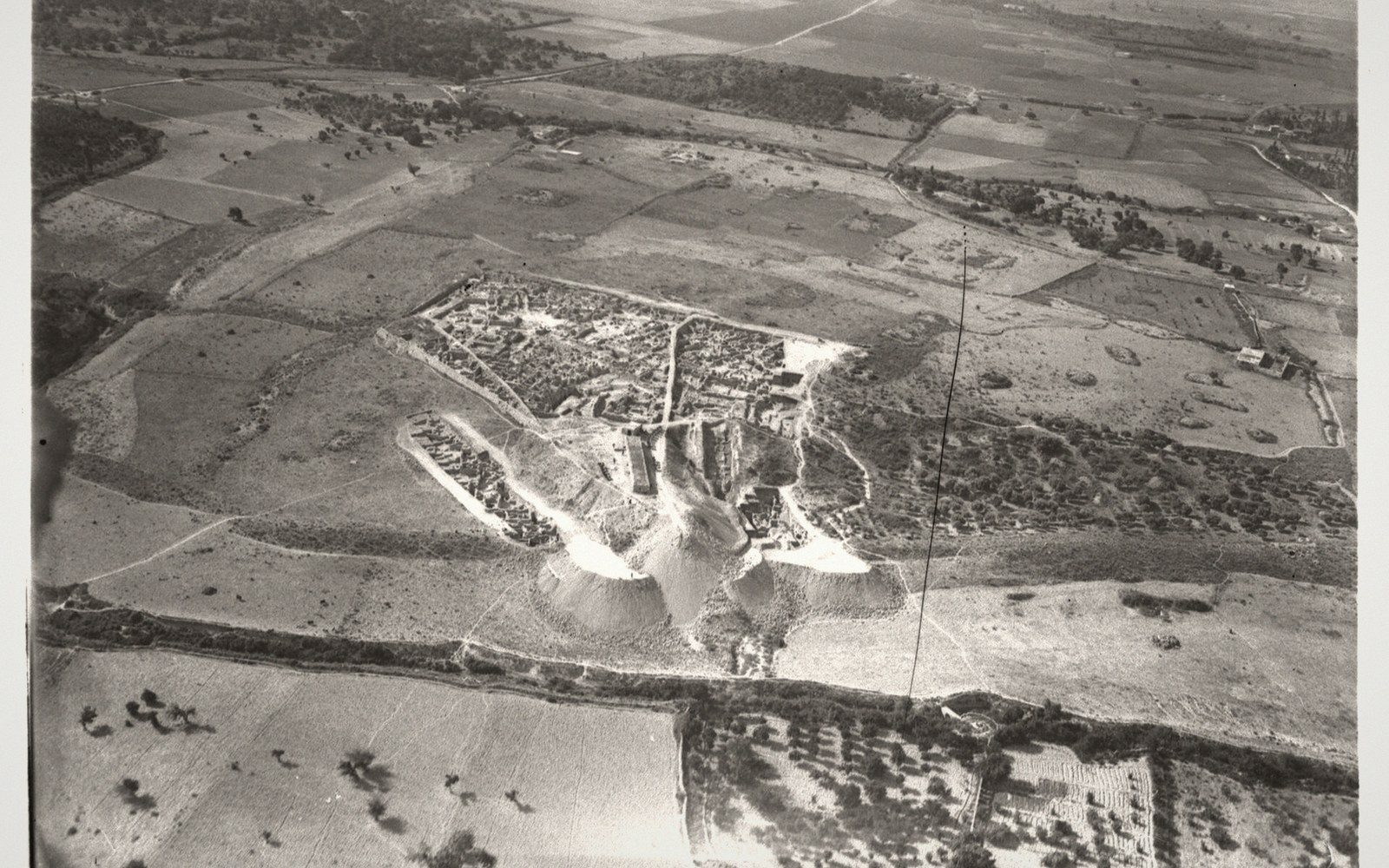 PLATE 2
The oldest alphabet in order
A single fired-clay tablet, no larger than a hand, carries the earliest known sequence of an alphabet written in the order we still use today. It came from Ugarit — the Bronze Age city buried under the tell of Ras Shamra on the Syrian coast — and it dates to the fourteenth or thirteenth century BC. The tablet is an abecedary: a teaching document, or a scribe's exercise, in which the signs of the Ugaritic cuneiform alphabet are written out from first to last. Because of it, we know that our familiar A-to-Z order is not a medieval accident or a Greek invention. It is at least three thousand years old, and it was already canonical before the city that produced it was destroyed.
Ras Shamra sits roughly 12 kilometres north of the modern city of Latakia, on the Syrian coast at approximately 35.60° N, 35.78° E. The tell had been accumulating since the Neolithic, but the Bronze Age city at its heart — Ugarit — reached its height between roughly 1400 and 1185 BC, when it was a major port and administrative centre trading with Egypt, Mesopotamia, the Aegean and Cyprus. In 1928 a farmer's plough broke through the roof of a Late Bronze Age tomb at the site's edge, prompting the French authorities to investigate. Excavations under Claude Schaeffer began in 1929 and continued for decades, eventually uncovering a palace archive of several thousand clay tablets, storage magazines, a scribal quarter and much else besides.
The tablet and the script
The Ugaritic script is not a direct ancestor of the Phoenician linear alphabet, but it is a true alphabet — it represents consonants, not syllables or logograms — and it appears to have been invented, or at least codified, at Ugarit itself. The script uses wedge-shaped cuneiform impressions on clay, the same technology used in Akkadian and Sumerian, but the signs are entirely independent inventions, not borrowings from Mesopotamian writing systems. Tablets from the palace archive show the script being used for administrative records, correspondence, mythology and ritual texts; the great Baal Cycle, one of the longest surviving mythological compositions from the ancient Near East, was written in Ugaritic.
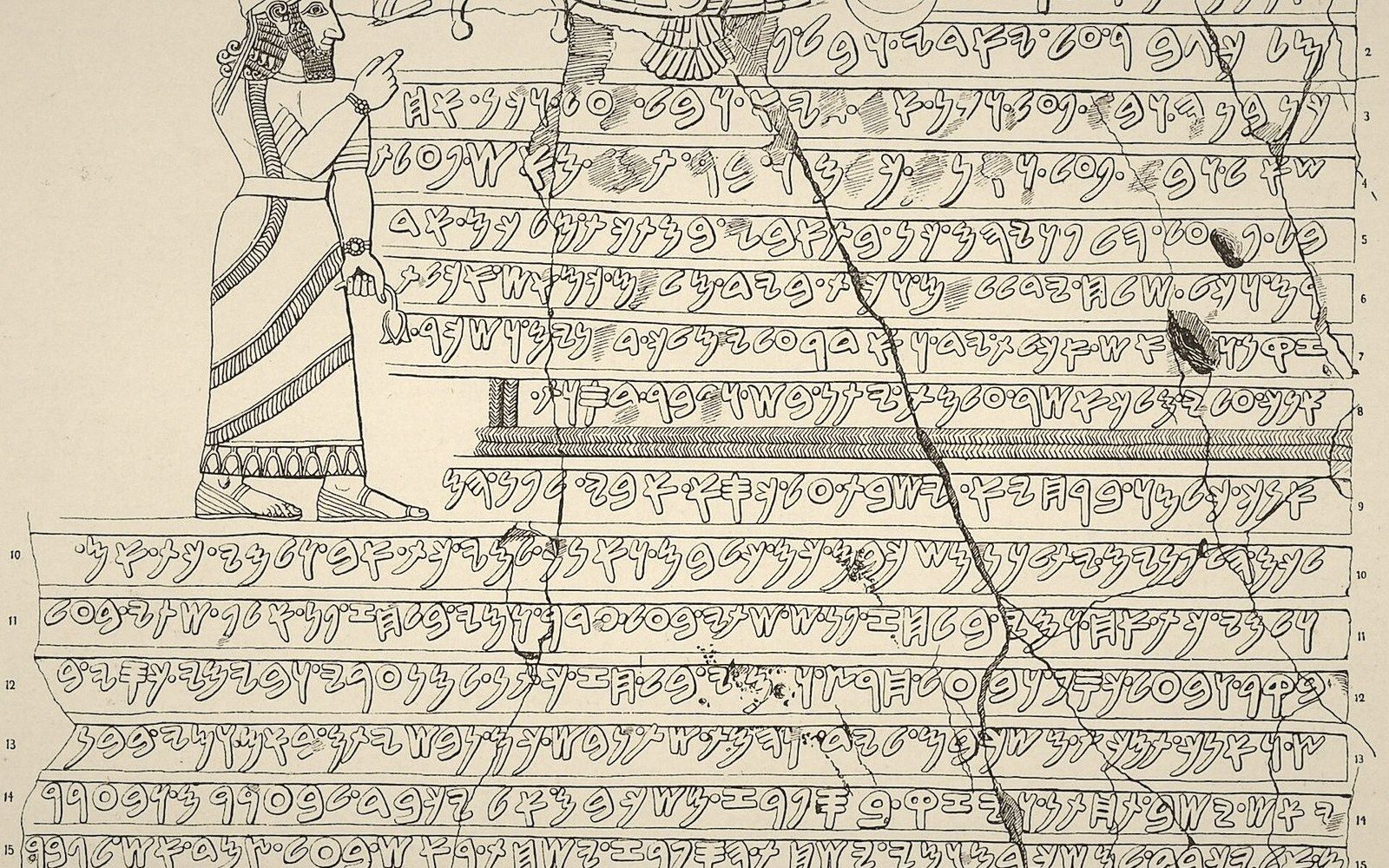 PLATE 3
The abecedary tablet — formally catalogued and housed in the National Museum of Damascus — lists the Ugaritic alphabet in a sequence of thirty signs (a standard version; some tablets carry a shorter, twenty-two-sign order that matches the sequence of the Phoenician alphabet more closely). The standard order begins with 'alpa, bêta, gamla — the precursors, in name and sequence, of the Greek alpha, beta, gamma. That continuity is not coincidental. The Northwest Semitic alphabetic tradition, of which Ugaritic is the earliest attested example in ordered form, feeds directly into the Phoenician linear alphabet, which in turn feeds into Greek and from Greek into Latin. When a child today recites A, B, C, D, the underlying sequence is traceable — with gaps and adjustments — to the order on this tablet.
The decipherment of Ugaritic cuneiform was achieved in 1930 and 1931, in a remarkable episode of parallel scholarship. Hans Bauer, a German Semitist, Édouard Dhorme, a French Orientalist and priest, and Charles Virolleaud, the epigrapher attached to the French excavations, all worked toward a solution at roughly the same time and with overlapping methods, each identifying different signs in a competitive sequence of publications. Virolleaud had been publishing the tablets as they emerged from the ground; Bauer and Dhorme worked from his hand copies. Within about a year of the first substantial tablet finds, the script was substantially cracked — an unusually fast decipherment made possible by the brevity of the sign list, the presumption that the language was Semitic, and the availability of bilingual clues within the archive itself.
Why order matters
The existence of a fixed sequence is not linguistically necessary. A script can function perfectly well without an agreed order for its signs — the sequence carries no phonetic or grammatical information. But the sequence matters for transmission. It is a mnemonic that allows learners to master and verify a complete sign inventory, and it is the mechanism by which a writing system is taught, standardised and passed from one generation or culture to the next. The fact that the Ugaritic abecedary exists at all tells us that scribal training at Ugarit was formalised, that the alphabet was understood as a countable, ordered set, and that this set was worth drilling into apprentice scribes as a sequence.
Multiple abecedary tablets have been recovered from Ras Shamra, not just one, which confirms that the sequence was a standard part of scribal education rather than a single scribe's idiosyncratic exercise. Some examples are simpler and less regular, consistent with student work; others are more carefully executed. Comparative evidence from slightly later sites — including a short abecedary found at Tel Lachish in modern Israel and examples on ivories from Megiddo — shows the same or closely related sequences circulating across the Levant in the late Bronze Age and early Iron Age, which points to a shared educational tradition rather than isolated local practices.
The city of Ugarit itself ended abruptly, probably around 1185 BC, as part of the broader disruption associated with the Late Bronze Age collapse. The palace archive — tablets still in their storage jars, some with urgent letters about enemy ships — was sealed by fire and abandonment. That destruction is precisely why the tablets survived: the burning hardened the clay, and the collapsed buildings buried the archive beneath metres of debris for three millennia. The abecedary tablet was among material recovered from the scribal quarter, a residential and working district adjacent to the palace where the evidence of writing instruction is densest.
It is at least three thousand years old, and it was already canonical before the city that produced it was destroyed.
The sequence the tablet preserves did not die with the city. It passed, through the Canaanite alphabetic stream that began with proto-Sinaitic and developed into the Phoenician linear alphabet, into every Western alphabet. The names of the letters — aleph, bet, gimel, dalet — survive in Hebrew and Arabic still. The order survives in every language that uses a Latin, Greek, Cyrillic, Armenian or Ethiopic script. The Ras Shamra abecedary is, in the most literal sense, the earliest surviving proof that the order was already fixed, already taught, and already considered authoritative — a curriculum fossil from a city that had been dead for three thousand years before anyone read it again.
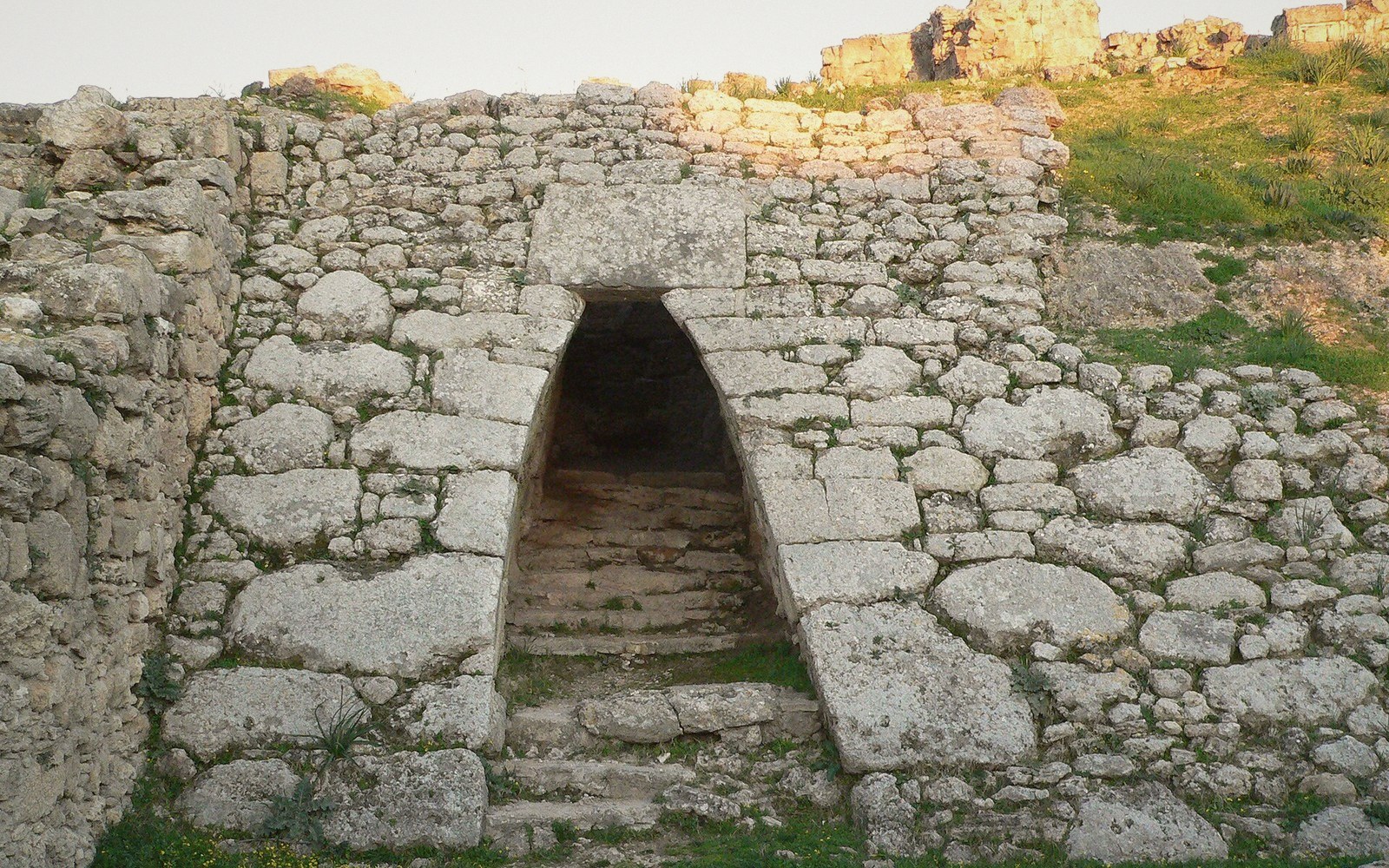 PLATE 4
 PLATE 5
Related entries