Appearing on this coast in the first century BC, it made glass fast enough to be ordinary within a generation.
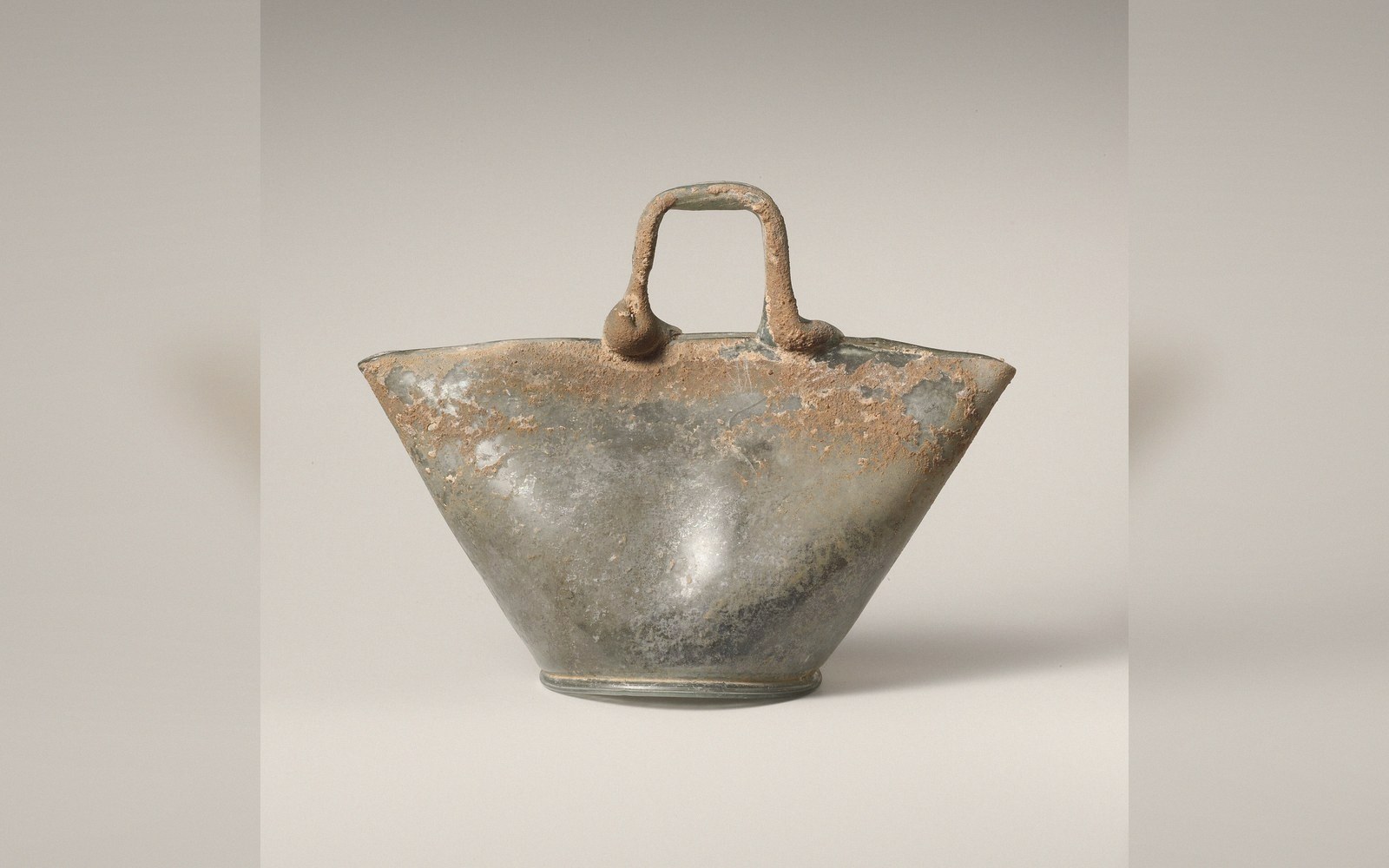 PLATE 1
 PLATE 2
How a hollow iron rod changed who could own glass
A tube of iron, roughly a metre long, held at one end and dipped at the other into molten glass — that is the whole technology. The blowpipe's appearance on the Syro-Palestinian coast in the first century BC is one of the most consequential moments in the history of material culture: within a single generation, it drove the cost of a glass vessel from precious to negligible.
Before it arrived, every glass vessel on the Levantine coast was made by one of two slow, labour-intensive methods. Glassworkers either wound molten glass around a clay-and-dung core, building up walls thread by thread, or cast it in open moulds and ground the surface smooth. Both methods produced small, thick, costly objects. A core-formed alabastron or amphoriskos from a Phoenician workshop of the fifth or fourth century BC might have taken an hour or more to make, and it shows: the walls are heavy, the volume modest, the form constrained by what the core permitted. Such vessels went to wealthy graves. The material record at sites across the Levant, and in collections including the Musée du Louvre and the National Museum of Beirut, shows core-formed glass clustered in elite funerary contexts, and nowhere else.
The invention and where the evidence puts it
The archaeological consensus, built largely from excavated vessel fragments and from kiln-site debris, places the invention of free-blowing — gathering a gob of molten glass on the blowpipe's tip and inflating it with a breath into a hollow bubble — somewhere on the Syro-Palestinian coast in the late first century BC. The region running from Sidon south through what is now northern Israel is most often cited; the ancient sources name Sidon in particular as a seat of glassworking expertise, and excavated evidence is consistent with that reputation, even if no single site has yet produced incontrovertible proof of the very earliest blowing.
 PLATE 3
What the record does preserve, in quantity, is the acceleration. Once the technique existed, workshops could produce a small blown flask in minutes rather than hours. Moulds quickly adapted to the new method: gather on the pipe, inflate partially, drop into a two-part mould, blow to full size — and the finished vessel carries the mould's decoration at a tiny fraction of the former cost. By the middle of the first century AD, blown glass vessels were travelling through Roman distribution networks to the furthest edges of the empire, turning up in British graves and Rhineland rubbish pits. The leap from luxury to utility happened that fast.
What blowing made possible
The blowpipe altered not just speed but form. A glassblower can manipulate the inflated bubble — elongate it, constrict the neck by reheating and pinching, pull a handle from a separate gather, crack off the pontil rod to open a rim — through a sequence of gestures that leave the glass wall surprisingly thin. That thinness is visually distinctive and, to the ancient consumer, an entirely new proposition: a vessel you could almost see through, lighter than a ceramic equivalent, sealed by its own material when full. The sensory qualities of blown glass are inseparable from the technology that produces them.
The speed and the thinness together undid the sumptuary logic that had governed glass for centuries. Before blowing, glass was confined by scarcity to contexts where scarcity was the point — the grave gift, the palace cosmetics jar, the diplomatic exchange. The Uluburun shipwreck, a Late Bronze Age cargo lost off the Turkish coast around 1300 BC, carried raw glass ingots and a small number of finished vessels as high-value trade goods, bulk only in the sense that copper was bulk. Blowing made that logic obsolete. Within a century of the technique's appearance, glass was an ordinary kitchen material.
Workshop evidence — slag, mis-fires, blowpipe tips fused with residual glass — has been excavated at sites along the Lebanese and Israeli coasts, confirming that production was distributed rather than centralised. The pipe itself, being iron, rarely survives. What survives is everything it made: a material revolution legible in the form of millions of thin-walled vessels, present in almost every excavated deposit of the Roman period and after, in quantities core-formed glass never approached.
Related entries